Showing posts with label insurance marketing. Show all posts

Monday, March 19, 2012

Timing is Everything -- When Should I Send My Marketing Emails?


I’ve been asked repeatedly when helping an agency start an email marketing campaign, “Is timing really THAT important? Can’t I just send these whenever?” If creating a successful email campaign was as easy as writing a sales pitch, using a few graphics to catch someone’s eye, formulating the perfect subject line, and sending your message there would be no use for this blog. Unfortunately, like most things, it’s never that easy. The day and time you choose to send your email is as important as your subject line, spelling your client’s name correctly or making sure your agency name is mentioned in your email. 

So, yes, timing really is that important. And, no, you can’t send your emails whenever you want if you expect to get a positive result. 

Dilemma of the Day -- I will let you know that a percentage of your readers will open your email no matter what day you send it on or what time. It is, however, not true for the majority of your readership and you should keep in mind the habits of most internet users during the day when calculating the right timing for your message.

Most people will hit social networking sites in the morning as opposed to checking their inbox because Facebook, Twitter and LinkedIn require less of a time commitment than checking their email. If your readers do check their inbox in the morning, they are usually working, and are checking their inbox for the first time that day. While on the job and in an attempt to de-clutter their inbox, you readers may delete your message labeling it unimportant at the time. 

Just as some people read their email as soon as they get them, there are a vast majority of your readers who will not see or open your email for several days once it’s been sent. At one time there was a commonly accepted statistic that a newsletter or marketing email had an open tail of three days. In recent years, this metric has changed though and most email marketers will allow up to five days after sending a mailing for stragglers to receive and open their mailings. You should keep this in mind while testing your open rates as well as the day and time you send it on.  This is also important if you’re sending a mailing that relates to a specific event or offer. At a minimum, try to send your email three days before your target event date. If you have the lead time, increase that to five days just to be sure all of your contacts are able to see your mailing prior to an event or offer expiration. 

Below are some guidelines that I’ve created based on my experience in email marketing. These are just a few fast and easy generalized tips to help you choose the best day to send mailings.  By sharing these tips with you, it does not mean you should stop testing your mailings to find out if these rules hold true for your agency. 
  • Internet activity in general reduces on weekends. This means Friday, Saturday and Sunday may not be as successful as other days to send your mailings. On Friday, people tend to check out before the end of the work day and will put your email off until next week, which really means, it’s been forgotten as soon as it’s come through their inbox. On Saturday and Sunday, it could be that folks spend more time with their family, have things to do around the yard, or they are burnt out from working on a computer all week. Almost every online metric category goes south on the weekend, and that includes email open rates.
     
  •  Now that the weekend is over and we’re all back to work, you may think everyone if refreshed and ready to check out your email. This couldn’t be further from the truth. Never send a marketing email on Monday. The fact is your readers spend most of their inbox time at work. When you come into work on Monday, if you’re like me, you start deleting anything that appears to be junk or non-essential so your inbox isn’t as overwhelming. Unless, through your testing, you’ve noticed that your readers exhibit a different pattern, avoid sends on Monday.
  • When you take out Monday, and the weekend, it boils down to sending emails on Tuesday, Wednesday or Thursday to yield the best results.

Morning, Noon, or Night? -- Early morning email sends have the lowest open rates. This makes sense when we look back at the patterns of most internet users who begin clearing out emails they deem unnecessary or unimportant as soon as they open their inbox. 

While metrics are different for different groups, as a general rule, the best open rates tend to come with emails sent around lunch time (noon or 1:00pm). People tend to relax a bit over lunch and are on the downhill of the day when they return from their break. In turn, emails sent in the afternoon do not have the same overwhelming feeling they may have in the morning.

If you’re going to send your mailings in the evening, when your readers have settled in from work, be sure they are optimized for mobile devices. Studies show that most people check email and social networking on their phone or tablet during commercials as opposed to firing up their laptop while watching TV. 

The only way to know for sure which day and time works for your audience is to run various tests and then select the best day and time based on your readerships response. Following the midweek – midday rule of thumb will yield a good result, but through your testing you may find a time and day that yields a greater response.

Friday, March 9, 2012

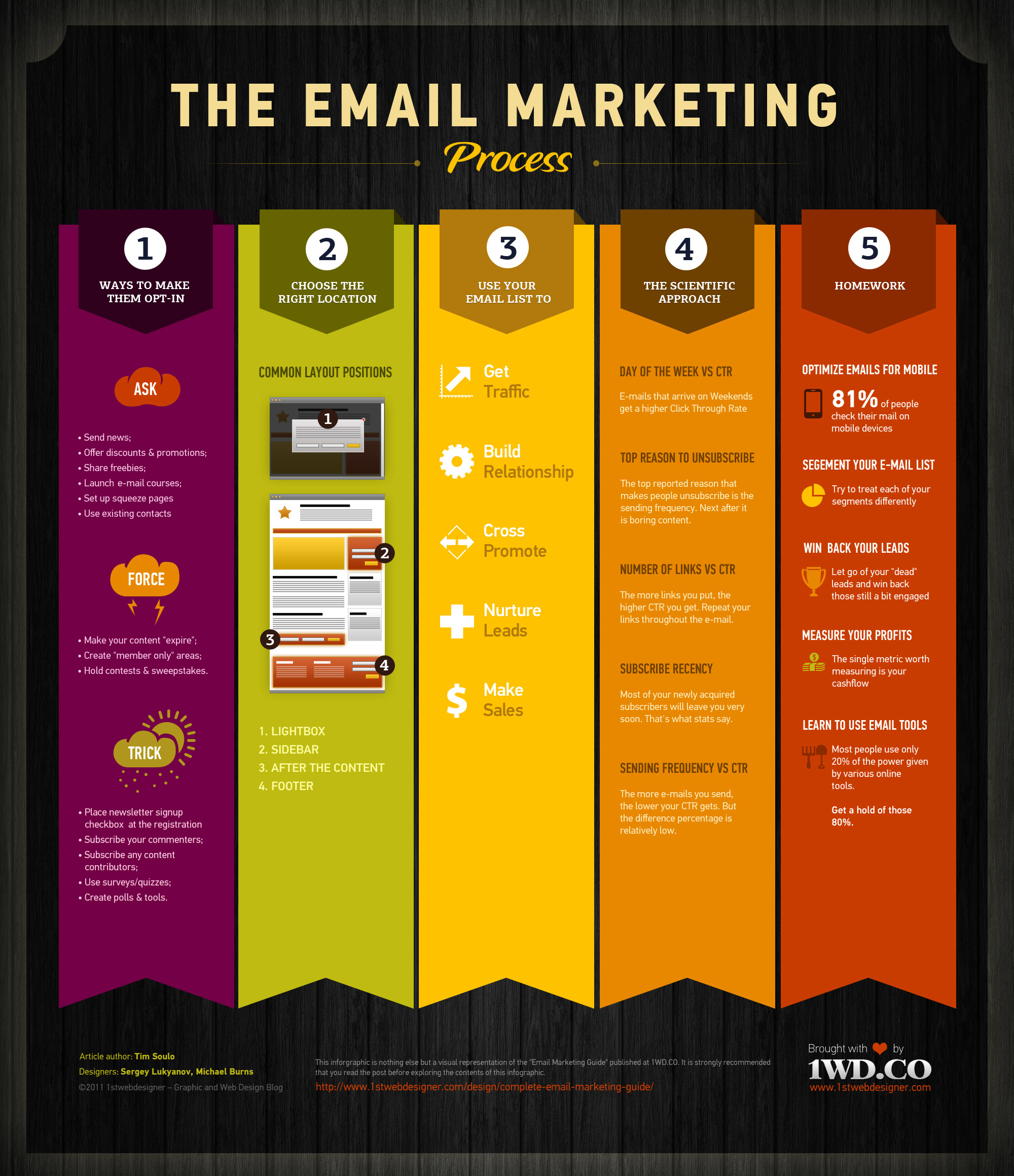
The Email Marketing Process

Since the dawn of email marketing, folks have been trying to figure out the science behind it. So far this is what we know; it's a touch of creativity, a dash of pizzazz, a hint of using the right buzz words at the right time, and a whole bunch of trial and error.

Knowing that many insurance agents and agency owners have limited time for trial and error, we've searched for an easy reference for you to check out while formulating your next email marketing campaign.

(Special thanks to Kirsten Thornton of our Insurance Website Builder and SEO team for finding this awesome infographic)

Tuesday, January 3, 2012

Writing an effective Subject Line

When you're writing an email subject line, there are a few tricks you can try to have your email commanding your reader’s attention.
Identify yourself
Recipients are more likely to open an email from a sender they recognize. Including your name in your subject line (or an abbreviated version) is one way to be seen in a crowded inbox. Display your agency name at the beginning of the subject line: ITC Agency: Your Online Quote for the most impact.
Be brief and to the point
Most email clients will cut subject lines off at 50 characters ("characters" include spaces). Compose a few engaging words and keep it under 50 characters so people see the full subject line. There are some schools of thought that suggest you can get the best results by reducing your email subject lines down to 35 characters.
Steer clear of spammer techniques
Your customers will keep an eye out for spam in their inbox to prevent identity theft and threats to their computer. Mimicking common techniques that spammers load their subject lines with is the fastest way to be deleted or end up in your recipient’s junk box. Being flagged as spam could also have your emails blocked by a recipient's email client.
Spammer favorites to steer clear of:
  • Using ALL CAPS or RaNdOm CaPs.
  • Hard selling in the subject line will raise suspicions instead of creating interest.
  • !!! -- Exclamation points are easy to abuse and it's important to stay away from them in your subject lines.
  • Using words like "free", "save", "win", "call now" and "toll-free". Leave them out of your subject lines if at all possible.
Practice makes perfect
You won't come up with the right formula on the first try. Analyze your email marketing campaign open rates to see which subject lines earned the most opens. Timing is also essential when it comes to how an email subject line is received. Sending an email with the subject of "Merry Christmas" on January 4th won't get much traffic.
By keeping a close eye on open rates and having relevant content, you should hit the right combination that puts you ahead of the competition.

Thursday, December 22, 2011

The Importance of Relevant Content in your Email Marketing: Content is King

Getting readers interested in joining your email campaigns is the most important piece of the email marketing puzzle. A question that many email marketers ask themselves daily is, “how do I engage my readers while gaining (and retaining) subscribers?”

Studies show that as humans our number 1 interest is ourselves. Putting this piece of information into play while composing your monthly newsletter can help you grab your reader’s attention. Granted, you can’t write hundreds of personal newsletters that speak specifically to your clients day to day lives (namely because that would be creepy and take far too long) but you can use code snippets to personalize newsletters with client’s names and you should tailor your newsletters to relevant activities in your community as well as a compliment to your insurance information.

 
If your community’s high school just won a championship game, talk about it; or if a new restaurant opened up near your office, go there for lunch and write a (positive) review about it in your newsletter. Being a part of your community can go a long way to gaining clients through referrals. Using community news is also a great way to gain subscribers who are interested in how your agency is protecting your community’s financial future.  

Some agencies write business nationally, so incorporating content that suits everyone on your contact list, in one email, may not be feasible. Instead, put together regional newsletters and use distribution lists so the content is still relevant to your readers.  You can be a part of your client’s community by writing about topics specific to their area. Write about a festival or activity many people are interested in specific to their region. Including recipes, sports, and other regional common-interest topics can go a long way to appearing as if you’re in many places at the same time. Pre-written content can save you a ton of time when having to write several email newsletters a month. There are hundreds of professionally written articles included with your AgencyBuzz email marketing account. They are separated by line of business, and new articles are added every month.  Be careful when using your pre-written content though as sending a newsletter about winterizing your home to a client who lives in Florida may reveal that you’re unfamiliar with your client’s area.

Use these community/regional events as a spring board into a relevant insurance topic that is complimentary to your other content.  This is an insurance newsletter after all. You can use these complimentary articles as another way to show yourself as the insurance expert your readers NEED to have a relationship with in order to protect their financial future. Not only are you educated on the latest insurance news that can save them time, money, and keep them from being left high-and-dry after an insurable event but you’re also saying that you’re just like them. You eat at the same places, you shop at the same stores, and your family values the community just like they do.

Engaging, gaining, and retaining subscribers is the name of the game when it comes to email marketing. And to win the game you’ll need to remember one thing, content is king.

Friday, December 9, 2011

Setting Up Your Email Marketing Strategy


So, you've decided to integrate email marketing into you agency’s marketing strategy, but where do you begin? It’s easy to get wrapped up in the excitement of starting something new and the potential sales you can gain by implementing email marketing; so much so that you can lose focus. By losing focus, your campaigns come across as a jumbled mess of too much information and no clear picture of what your readers are to take away from your message.


Setting Up Your First Campaign:

  • First, you want to set a quantitative goal for your campaign. This does not have to include numbers, but just a clear picture of what you want to accomplish with your drip campaign. (i.e. generate new leads, gain policy sales, drive traffic to your site, or begin a referral program, etc. ) By setting your ultimate goal in the beginning, it will keep your campaign focused.

  • The next thing to remember is to include a call to action in all emails. This is a way for contacts to interact with you once they’ve received your email. Ask them to visit your site, download a free information report from your website, give you a call, or even join your Facebook page. Anything to engage them once you’ve given them the information is a call to action.
  • I recommend either creating or purchasing a custom email template that is branded after your website. Include a button for subscribers to easily click through to your site and get a quote. You should also include your logo, phone number, and social media icons so contacts can easily join your social networking sites. Creating a consistent online brand will help leads and clients alike recognize mailings from your agency, therefore increasing your open rate.
  • Once you’ve created or purchased your custom email template, you should create and automate a welcome email that is sent to all contacts added to your database. Automating this process ensures all leads are communicated with instantly. You should also create birthday and holiday cards that will automatically send to your contacts every year. This will create a concierge touch to your agency’s communications.

  •  Finally, you should set up interoffice reminders for a contacts primary agent to call them as the final step to all drip marketing campaigns. Calling your contacts and having a one on one conversation with them could be the missing piece that closes the sale. 
Now you're ready to start selling insurance all over your state, just using your email address. 

For more information on setting up successful email marketing campaigns, give us a call at 1-800-383-3482 and ask to speak with someone about AgencyBuzz. You can also visit our website at www.agencybuzz.com